BlackMirrorisacompleteproductIdesignedandbuiltforarealbarbershopatSteliouKotiadi44inRhodes,Greece:booking,asmartstore,loyalty,marketing,stafftools,financesandnativeapps,ontheweb,iPhone,iPadandAndroid.Itbeganasawebsiteandgrew,oneordinaryproblematatime,intothesoftwaretheshop'sdaynowpassesthrough.
Built with
- React
- TypeScript
- Tailwind
- Vite
- Postgres
- Supabase
- Expo
- Swift
- Kotlin
- Cloudflare
How it started
This is not a concept or a demo. Black Mirror is a working barbershop in Rhodes, and its barbers and customers use this app for real appointments.
A barbershop looks simple from the outside. There are a few chairs, a few people and a list of times. Then the questions arrive. What happens when a barber takes a break, when someone cancels, when a walk-in sits down, when a regular wants only one person to cut their hair? Each answer became a rule in the system, and most of the early work was finding out which rules the shop already followed without ever having written them down.
I came to it from two sides, as a customer of the shop and as its developer. Antonis Taramonlis, the owner, brought the third: how the place really runs. Many of the best ideas came out of our conversations, and working with him was one of the best parts of this project.
Booking
The first version had one job: let a person choose a service, a barber and a time, then trust that the chair would be waiting. Everything since has been built to protect that small moment of trust.
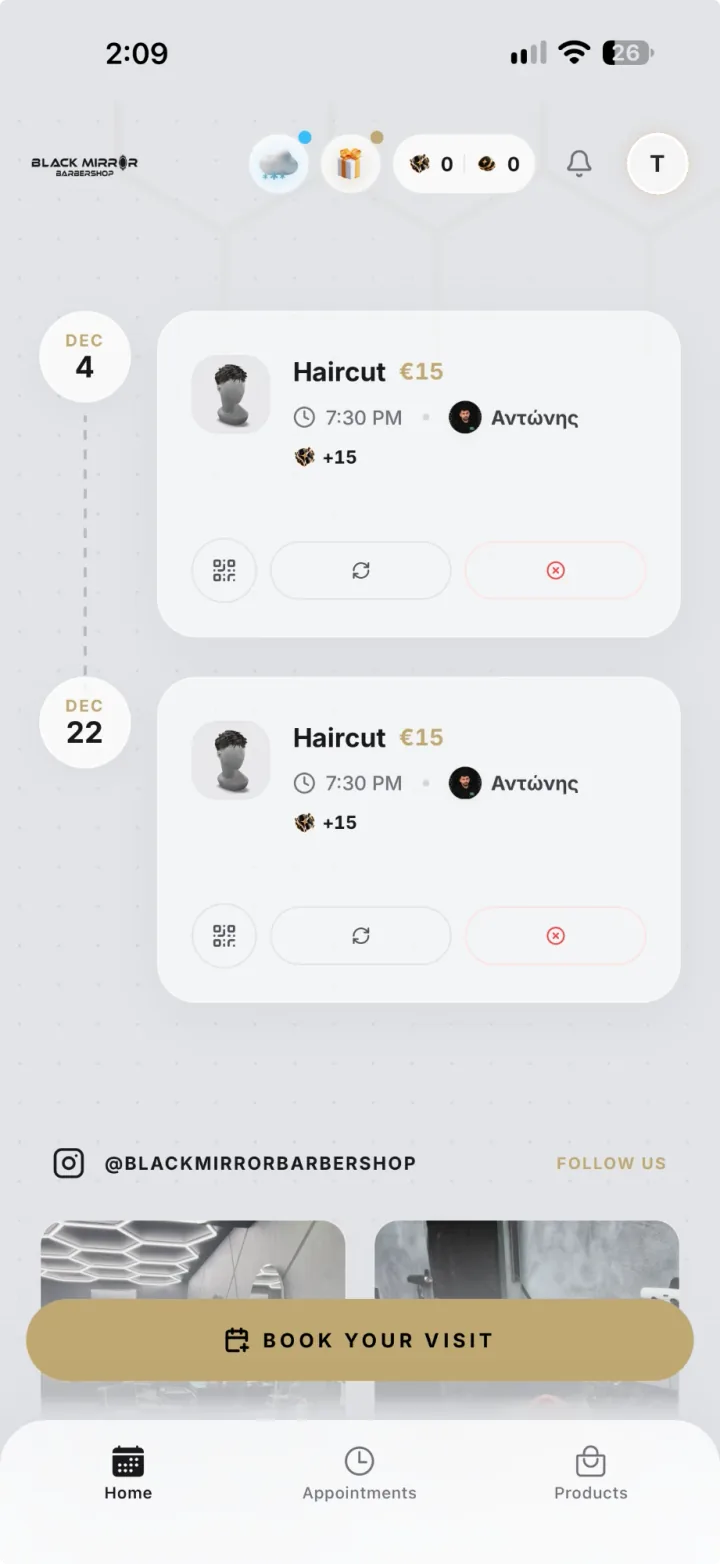
Every barber appears at the same size, so nobody loses work by sitting lower on a list, and your usual barber carries a small gold tag. Reminders arrive before the visit, a personal code checks you in at the door, and changing your plans takes a few taps. When a day is completely booked, you can join its waiting list instead of meeting a dead end, and hear the moment a chair opens.
A time slot is a small promise between two people who haven't met yet that day. Most of the engineering in this project exists to keep it.
The 3D hairstyle picker
Describing a haircut is surprisingly hard. People hold up a phone, point at their own head, or say "the same as last time, but shorter". So I added 3D models to the booking flow. A customer can turn a head on screen, look at a style from the side and the back, and bring that choice to the appointment. The barber sees the chosen style on the calendar before the customer arrives.
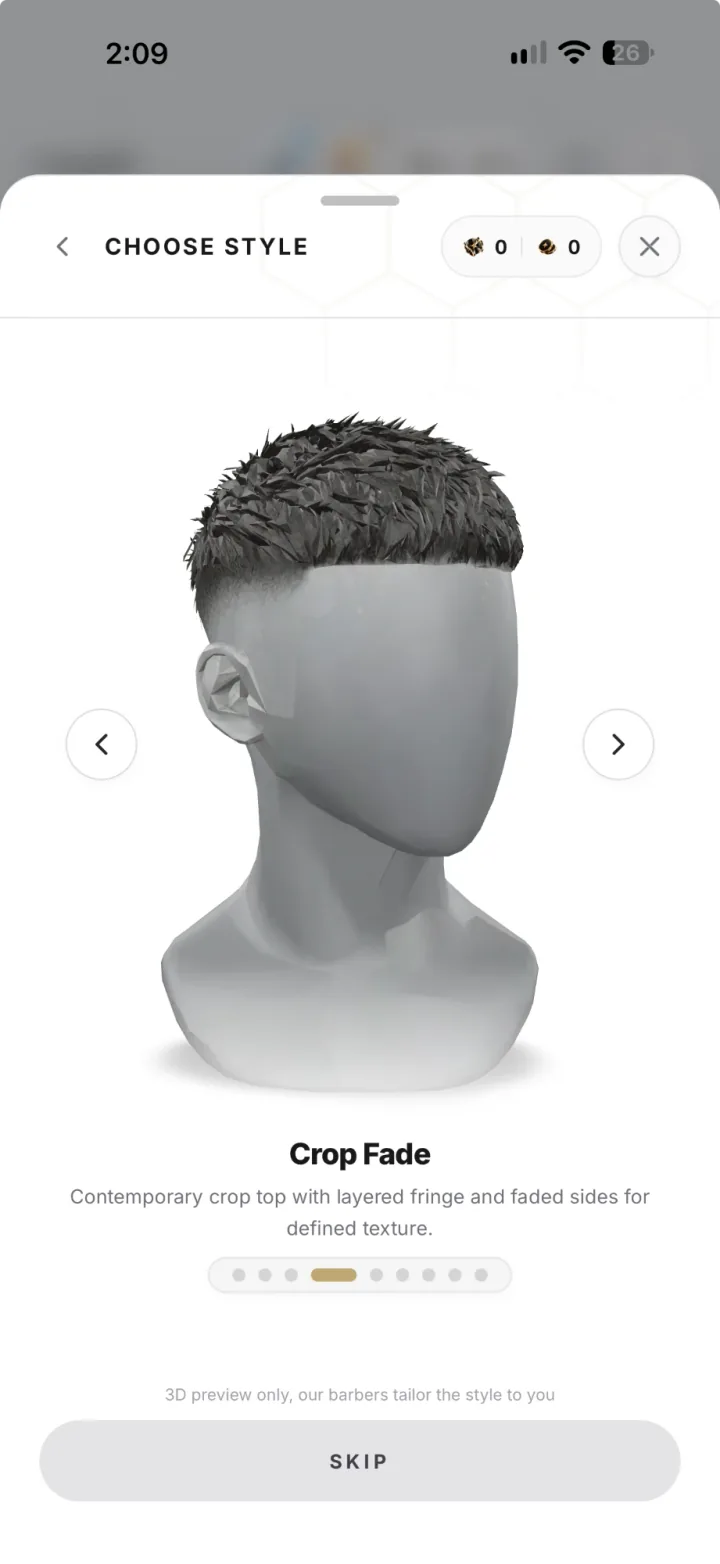
3D is heavy, and a booking page has to feel light on an ordinary phone on a weak connection. The viewer loads only when someone reaches it, and I spent a surprising amount of time on small things, such as fading the base of the bust into the page so it reads as an object in the room instead of a model in a box.
In a barbershop you usually meet your new haircut in the mirror, when it is too late to change your mind. The picker moves a small part of that moment to before you sit down.
A store that pays attention
Most online shops show everyone the same shelf. I wanted this one to behave like a good barber, who remembers what you use and knows when to mention it.
A shelf that arranges itself
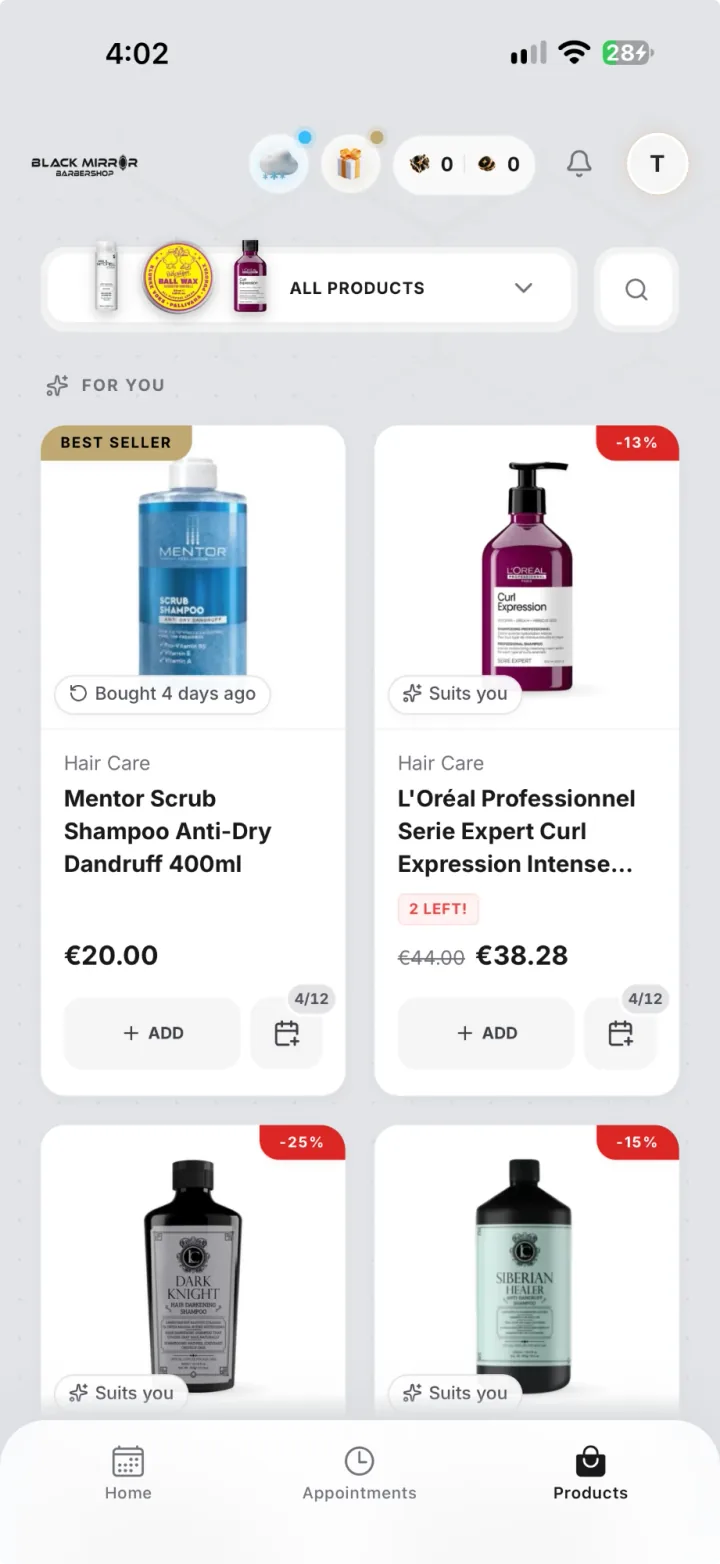
The product order is never set by hand. Every day the system reads what has been selling, with recent sales counting more than old ones, and rebuilds the shelf: best sellers first, then a deal, then something worth discovering, without placing the same brand side by side. Sold-out products step to the back, so the first thing you see is always something you can actually take home.
For you
Each customer gets a personal row, and every card says why it is there: the product your barber used on your hair, something you bought before, or something that suits what you already love. New arrivals take turns at the top, so a small catalog always has something fresh to show.
Running low?
A bottle of shampoo has a lifespan, and so does a jar of clay. The system knows roughly how long each kind of product lasts, and shortly before yours should run out, it asks a simple question: running low?
Back in stock
If something is sold out, you can ask to be told when it returns. The alert does more than announce it. It offers to add the product to your next appointment, and if you don't have one, it starts a booking with the product already in your cart.
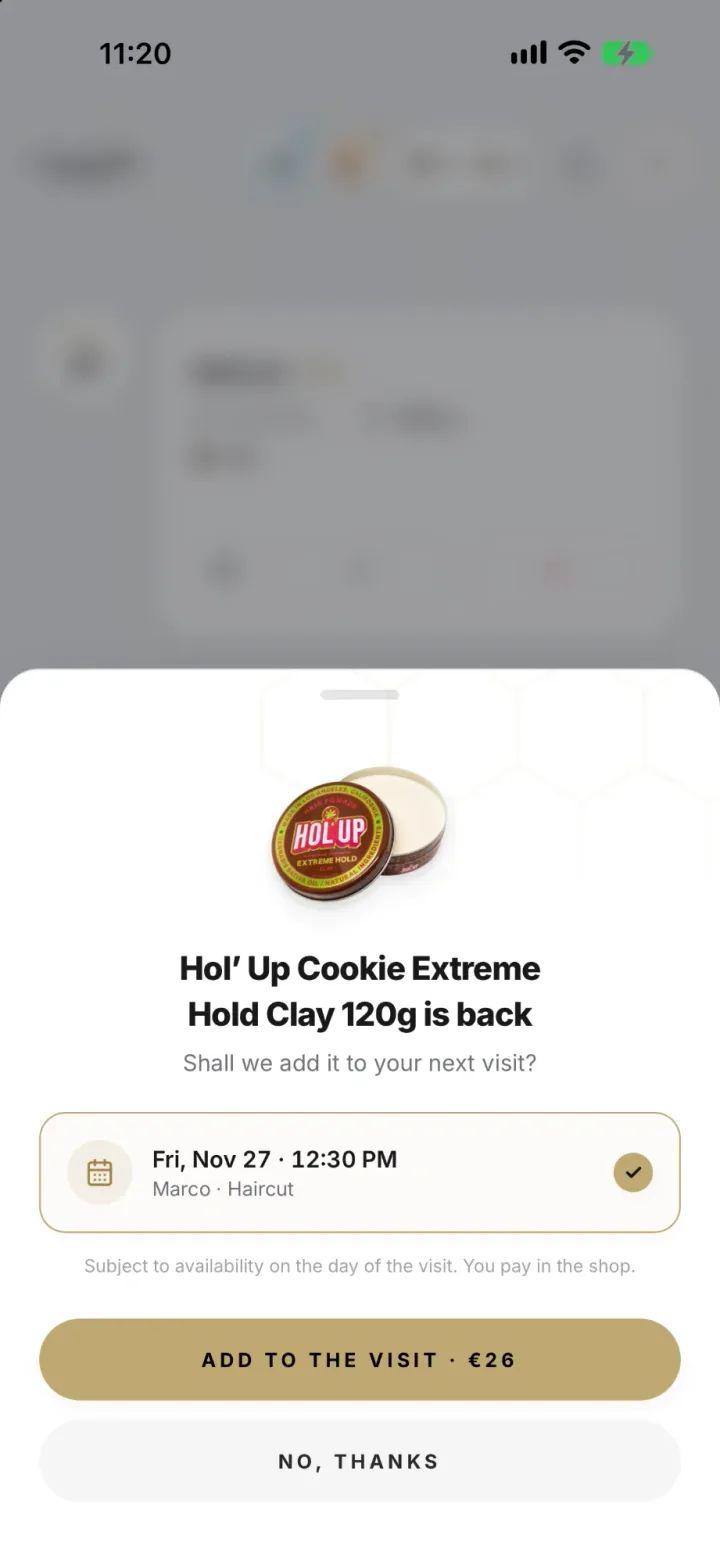
Product of the day
Once a day, the shop presents a single product, chosen from what is on offer, new or loved, and never repeated too soon. It appears in the app and on the iPhone home screen as a widget, so the store quietly exists even when the app is closed.
Picked up at the chair
If you already have an appointment, you can set a product aside and collect it at your visit, so buying something becomes part of the haircut instead of another errand. While booking, the "anything else?" step leads with what people love and the easiest things to say yes to.
Marketing that feels like attention
Most marketing shouts because it knows nothing about you. A good neighborhood shop has never needed to. It remembers your name, your barber and how long it has been. I wanted the software to earn that same familiarity.
A gift before the first visit
Visitors who are about to book are offered a small welcome gift for opening an account, designed like a real voucher with a tear-off stub. It turns an anonymous visitor into someone the shop can remember.
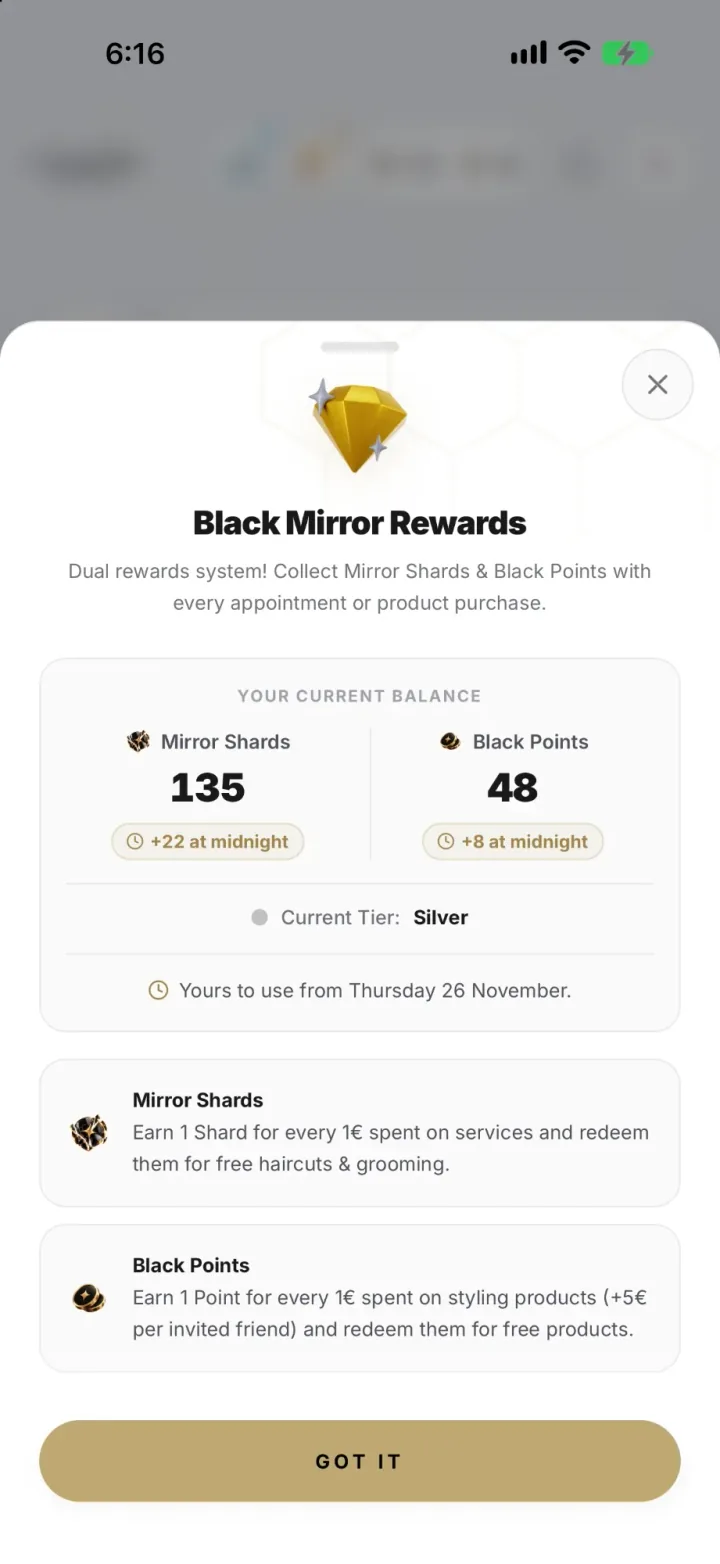
Two kinds of reward
Services earn Mirror Shards, which become free haircuts and styling. Products and referrals earn Black Points, which become free products. Membership tiers give regulars something to climb, and rewards earned today arrive at midnight, a small reason to open the app tomorrow.
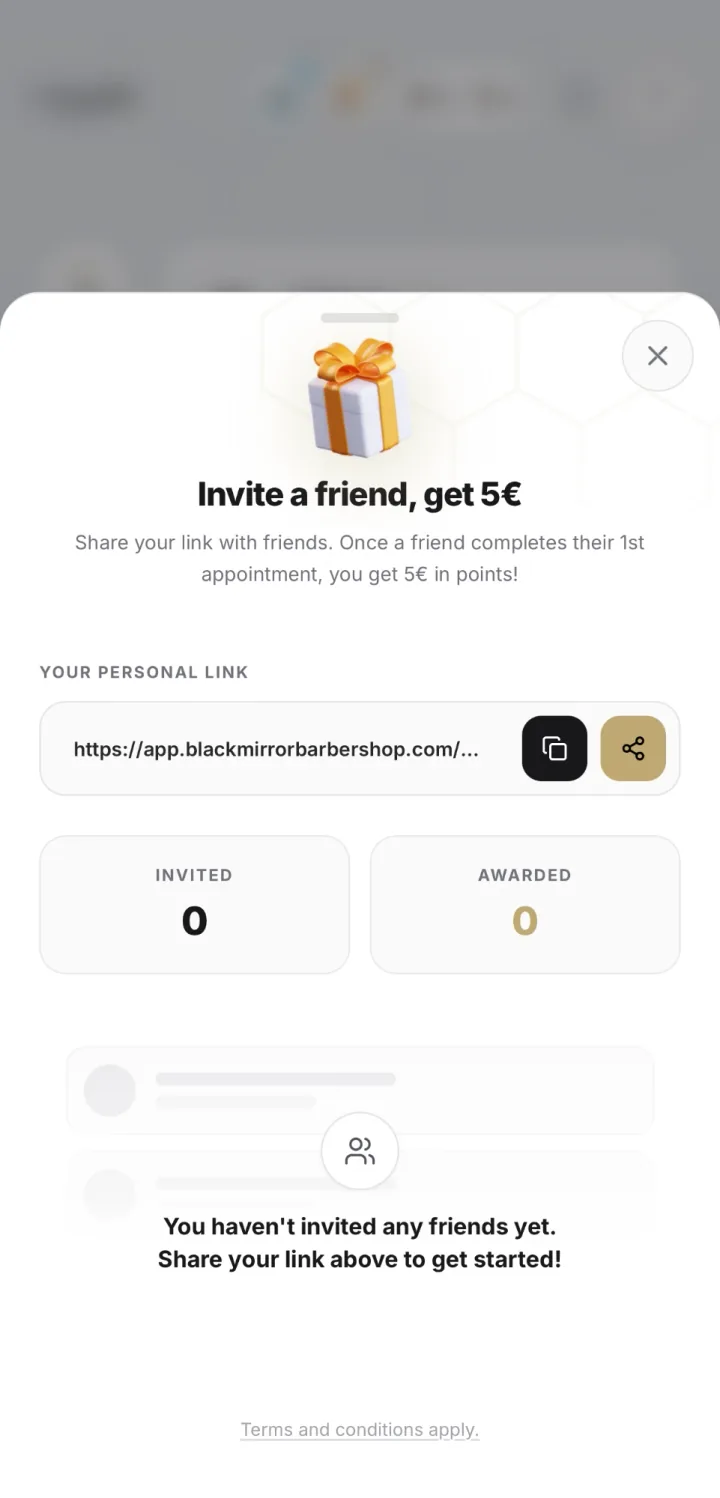
Word of mouth, with a link
Barbershops have always grown by word of mouth, so that became a feature too. After their first visit, every customer unlocks a personal link, and when a friend completes their first appointment, the person who invited them earns €5 in points.
The right message, or none
The day after a visit, you can receive the products your barber used on you. If weeks pass, a gentle reminder suggests your next cut. After a longer silence, the shop simply says it misses you. Ten minutes after a visit, while it is still fresh, it asks how it went.
The most important rule is the one that limits all of this. A customer receives at most one marketing message a week, the most useful one wins, and anyone can turn them off. Popups wait their turn and never land on top of what you are doing. Attention stops being a gift the moment it becomes noise.
Small delights
Snow falls in December, fireworks open the new year, and a Black Mirror Kids line has its own friendly stamp. None of this is necessary. That is why people notice it.
The control room
Most of Black Mirror is the part customers never open. It is where the working day actually runs: who is in, which chair is free, what was sold, and what the day added up to by closing time.
The calendar is the center of it. Staff book walk-ins, set up repeating appointments, drag and resize visits with a mouse or a finger, add breaks, open a single day for someone who is usually off, and scan a customer's code at check-in. It has to be fast enough to use with one hand, between two customers, while someone is waiting at the door.
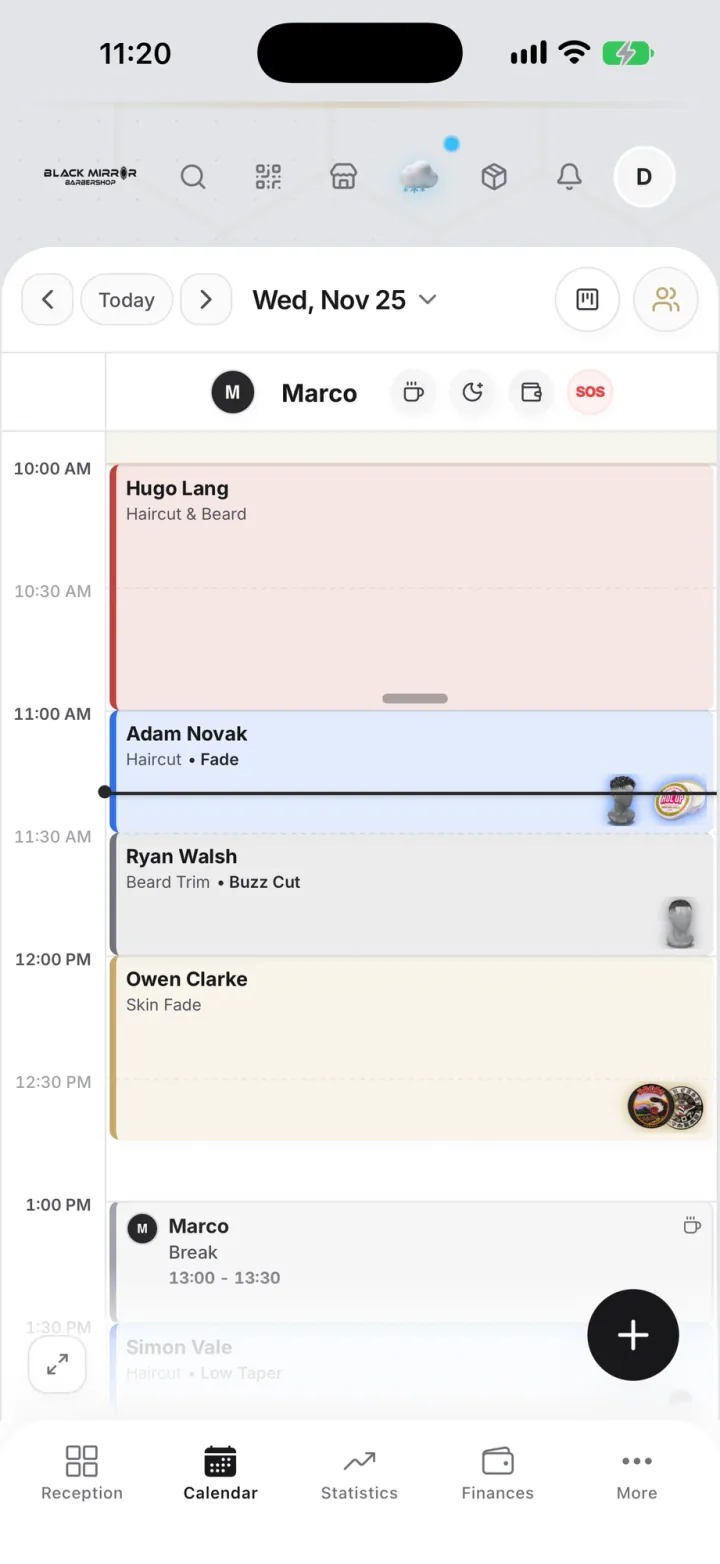
The memory of the shop
Around the calendar sit client histories, services, retail stock, the consumables used behind the chair, take-away sales, opening hours, time off, reviews and notifications, with a command menu to reach any of it in a moment. None of these parts is especially hard alone. The difficulty is that they all touch each other, so one change to an appointment can reach a barber's day, a customer's inbox and the numbers at the end of the month.
Finances and payroll
The money was the part I trusted least until it had been proven wrong a few times. Every finished visit flows into the shop's finances, alongside expenses, bonuses and payroll, and any barber's day can be opened and explained line by line. Statistics, leaderboards and forecasts show how a month is really going. The hardest mistakes there were the ones that looked reasonable, because a wrong number on a dashboard doesn't look like a bug.
Who may do what
A barber, a receptionist and a manager need different versions of the same screen, and each person should see what their work requires and nothing more. Every rule has to hold on the server as well as on the screen, and each new feature has to answer the same question again.
The bad mornings
Sometimes a barber can't come in and their whole day is already promised to other people. One SOS action clears that column, leaves anyone already in the chair untouched, and tells each affected customer which other barbers are free, with a way to rebook in one click. It is one of the few actions in the system that cannot be taken back, so it took more thought than its single button suggests.
Customers see a time slot and a confirmation. Behind it, someone is deciding what the shop owes to the people who trusted that slot when the day stops going to plan.
One product, every screen
My first mobile app rebuilt every screen separately. Then I replaced it with a native shell around the live web app, with native navigation, haptics, notifications and one shared product on the inside. I gave up the idea of a fully native interface in exchange for something a small project can actually maintain: a fix to the website reaches every phone at once.
The native layer is where it earns its place. Your appointment lives on the Lock Screen as a Live Activity, barbers can follow their shift the same way, and the Product of the Day sits on the home screen. Sign-in works with passkeys, the whole product speaks Greek and English, and when the connection disappears, the app says so calmly instead of breaking.
The stores had their own lessons. Every round of feedback became a rhythm of small repairs, and things that looked finished on my desk had a way of behaving differently on someone else's phone.
Real devices taught me the rest: screens I had never tested, connections that only pretended to work, requests that never came back with an answer. So the app learned to stop waiting, recover and try again. Software spends more of its life on bad Wi-Fi than on the desk where it was written.
Built to be relied on
Once real bookings lived here, a mistake had a cost. I separated development from the live system, made every change rehearse on a copy first, and put automated tests and checks between my keyboard and the people using it. Nobody sees this part, and that is how you know it works.
What this gives a business
You don't need to care about any of the technology above to see what it does. A gap in the calendar gets a second chance through the waiting list. A customer who drifted away hears from the shop before finding another one. A sold-out product becomes a sale the day it returns, and a bottle about to run out becomes a reason for the next visit.
The owner sees the day, the money, the stock and the team in one place. The staff get the tools their work needs and nothing more. The customer simply gets a shop that seems to remember them.
None of this is really about hair. Any business built on appointments and people who come back asks the same questions: a clinic, a studio, a salon, a gym. If yours does too, this is the kind of system I love to build.
What I learned
The hardest problems did not appear while I was building. They appeared on ordinary working days, with real customers trying to book and barbers already at the chair. A schedule that looked correct on my screen could behave differently once breaks, cancellations, late arrivals and changed plans met in the same afternoon. Fixing anything meant working carefully around a system people were relying on at that very moment, then looking for every other place the same misunderstanding could be hiding. There were usually more. None of them ever disrupted the shop's work, but that was never the only measure. In a place built on small rituals, the details are the difference.
The most useful correction came from the shop's own reality. My instinct was to make the calendar strict, but barbers stay late, open on a day off, and fit in someone they have known for years. So customers follow the schedule, while staff can step outside it, and those appointments are never removed by the system.
A schedule records what usually happens. The people working inside it need to be able to overrule it.
Most people who use Black Mirror will never think about any of this. They will pick a time, sit down, look up at the mirror and leave feeling a little better than when they came in. That is how it should be. The best software in a barbershop is the kind you forget was there.